Showing posts with label Filming New Zealand in Peace and War. Show all posts

Tuesday, February 20, 2018

Plaudits continue for The Camera in the Crowd

There’s been no let-up in the positive reception to Christopher Pugsley’s major work on the early years of film in New Zealand.

Russell Baillie’s review in the Listener summarises The Camera in the Crowd in an informed and readable summary:

For Newshub, Tony Wright picked up on some of the key First World War footage featured in the book, filmed by Henry Armytage Sanders:

And reviewing the book for Radio Southland, Terry Toner described it as “a mighty gift to the country!!”.

A key element of the book is the linkages it provides to the actual film, much of which can be viewed on the website of Ngā Taonga Sound & Vision, the national film and sound archive in Wellington. 

Photos and text are part of the Ngā Taonga home page:

Christopher Pugsley will be talking about the book and sharing imagery with Chris Bourke at the Writers and Readers Festival in Wellington on 11 March:

Monday, December 11, 2017

Lights, camera, action for The Camera in the Crowd

There was indeed a crowd in Wellington for the Thursday 7 December launch of Christopher Pugsley’s seminal new book, The Camera in the Crowd: Filming New Zealand in Peace and War, 1895 – 1920.

Appropriately, the evening event took place at Nga Taonga Sound & Vision, the home of New Zealand’s film archive and a key partner in this account of the dawn of film in Aotearoa.
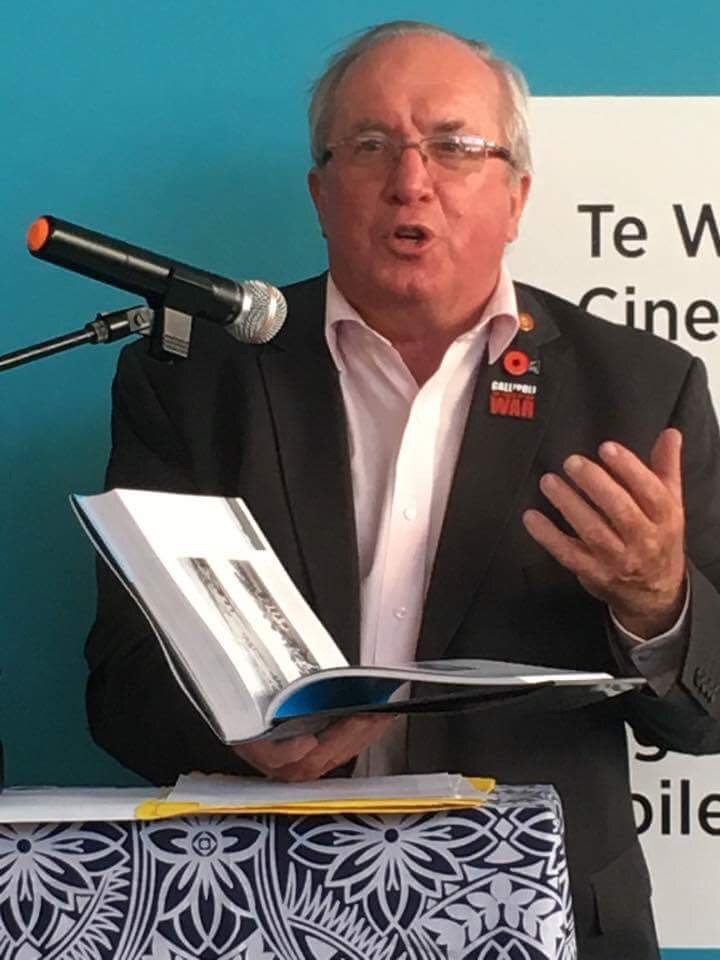
Christopher Pugsley speaks at the launch

Author Dr Christopher Pugsley spoke of his long journey to uncover the story of our early filmmakers and cinema impresarios, and his gratitude to the many collaborators and experts who supported him along the way.
Sarah Davy of Nga Taonga Sound & Vision
Nga Taonga Sound & Vision Group Manager Information Services Sarah Davy spoke of the pride the organisation feels at seeking the film history brilliantly captured in print form, and of the work that is going in to accompanying the book with online film footage and information.
Unity Books were kept busy by guests obtaining their signed copies of the 536-page hardback.

And of course, there were cameras in attendance! A selection of photos follows.

Christopher spoke the next morning on Radio New Zealand’s Saturday Morning show with Kim Hill. The Radio NZ site prefaced the book thus:
Christopher Pugsley is a respected and much published military historian – but what is not as well known is that he has a passion and a deep knowledge of film history. Pugsley's new book, The Camera in the Crowd, is the result of nearly three decades of research – the story of film in New Zealand for its first 25 years, 1895-1920, told largely through the footage that has survived in the archive of Nga Taonga Sound & Vision. It covers the last years of the Victorian era and the first two decades of the 20th century – a period that encompassed great political, technological and cultural changes, including the First World War. It tells of the cameramen, of the film they took - not only at home but also of the Kiwi 'Diggers' in the First World War - and how the public reacted to it.

Click here to hear the interview:

And here are additional links to other coverage:

Friday, December 1, 2017

Monumental history illuminates the dawn of film in New Zealand


More than 20 years in the writing, The Camera in the Crowd: Filming New Zealand in Peace and War, 1895–1920 is a magnum opus — the first book to document fully the beginnings of filmmaking and cinema for and by New Zealanders.

In 536 pages this sumptuous hardback brings to life the first 25 years of film in New Zealand, from the arrival of the first kinetoscope technology through the building of cinemas, filming for tourism promotion, cameramen working in the First World War and the arrival of 'talkies'.

"This is the book that I've hoped that someone would write," comments Sir Peter Jackson in his enthusiastic foreword.
Luxuriously illustrated with over 350 photos, film stills and ephemera, the book mimics those early experiences of film, as the author explains:

"Film is made to be seen on screen and this book reflects this by providing stills from the films discussed. Titles of surviving films are also identified by a small projector in the margin that allows you to access the film online and pause and have a look at what you are reading about.

"Each page also includes a still from the 1914 film Auckland's Expeditionary Force  ... you can enjoy this segment by flipping the pages in the manner of the once very popular flip books."
One of the 268 'flip book' images
Christopher Pugsley is best known for his military histories including Gallipoli: The New Zealand Story, and it was that expertise that led to his working for the then New Zealand Film Archive in the early 1990s. From there grew his passion for film history that has continued with the current Nga Taonga Sound & Vision, which has furnished the images and information for much of the book.

As Sir Peter concludes his foreword:

"You are holding a treasure trove in your hands. It's time to peer through that peephole and see our country of 100 years ago come alive again.


"Thank you, Chris."

Christopher Pugsley is one of New Zealand's most respected historians. Formerly a Lieutenant-Colonel in the New Zealand Army and a lecturer in military studies in New Zealand, Australia and the UK, he has writen numerous works of military history including Gallipoli: The New Zealand Story and The Anzac Experience, and was historical director of the Gallipoli: The Scale of War exhibition at Te Papa Tongarewa, the New Zealand National Museum in Wellington. He lives in Waikanae Beach. 


Publication Date: 29 November 2017  |  ISBN: 978-0-947506-34-6 |  RRP $80

Paperback, 270 x 215 mm, 536 pages (8 pages colour)


Related Posts Plugin for WordPress, Blogger...